Announcements, product launches and release notes from YambaCode AB
and its network of AI & biotech apps.
RELEASESLAUNCHESCHANGELOG
RESEARCH PROGRAMMEMATHEMATICSINTERACTIVE
Goldbach as geometry, parity and correlation
A visual research programme by Christopher Yamba, developed with AI-assisted investigation, explores Ferrers diagrams, prime-pair graphs, sieve barriers and parity-sensitive proof targets. An accompanying interactive graph traces the ideas and their sources.
Goldbach's binary conjecture remains open. The programme is an author-published research exploration, not a proof; its analytic deductions have not received external peer review. Selected elementary statements have been checked separately where indicated. Christopher is developing a complementary approach for a future follow-up.
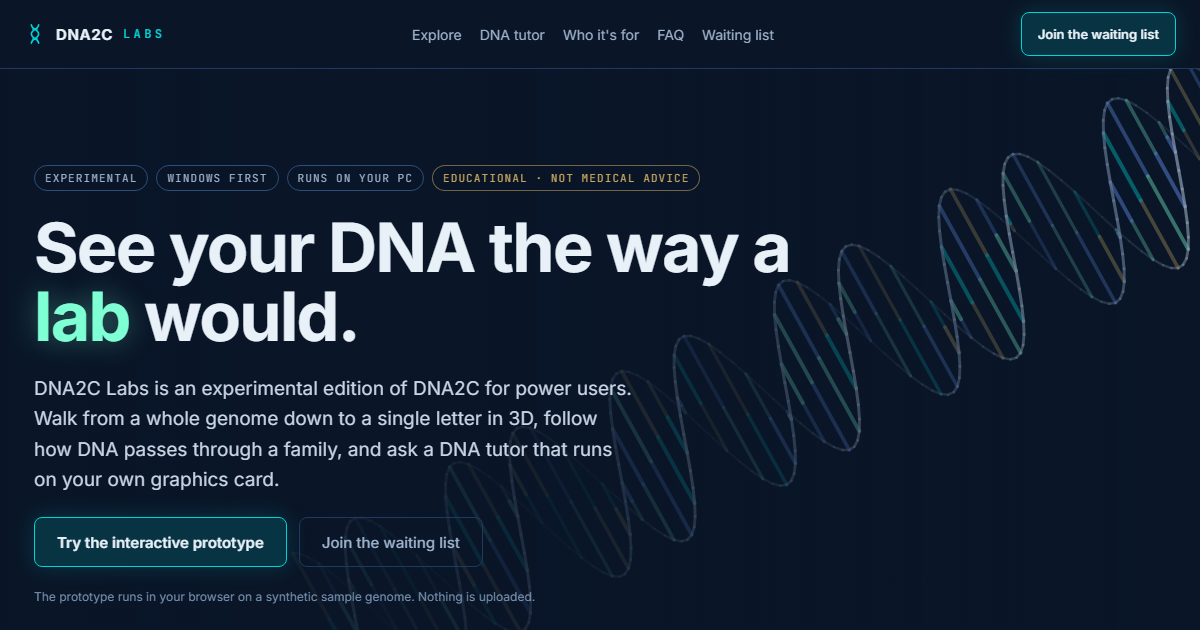
We are exploring DNA2C Labs, an experimental edition of DNA2C for
power users on Windows PCs: DNA in 3D from genome to single letter, protein structures, family
inheritance and guided lessons, with an optional DNA tutor powered by
Carbon-X,
an open DNA-and-English model that runs on your own graphics card. Your DNA stays on your PC.
No release date or price yet. Try the browser prototype (synthetic sample genome) and join the waiting
list. Educational, not medical advice.
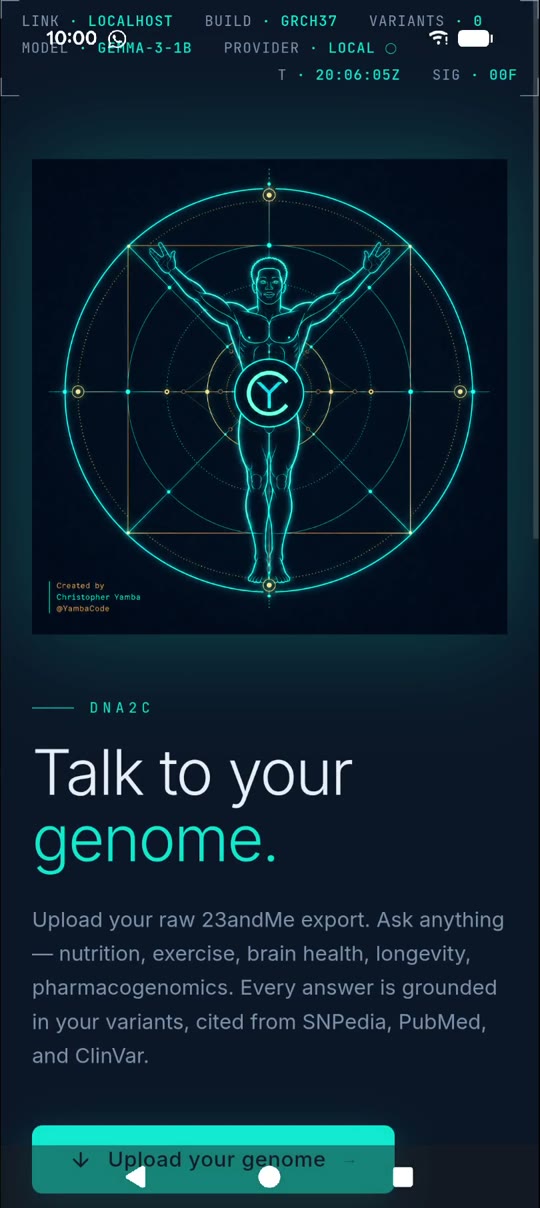
DNA2C, private AI for your raw DNA data, is now on Google Play.
Its AI model (Google’s Gemma 3) runs on your phone: load the raw data file from your 23andMe
or AncestryDNA test, ask in your own words (how do I process caffeine? can my body make omega-3 from
plants?) and get answers with sources you can check. Your DNA file and genotypes stay on your phone.
A one-time purchase on Google Play; no account, no ads, no tracking. It replaces the early-access
download. For education only, not medical advice.
Five diagonals for tripled letters: version 2 of the Parikh completeness paper
Version 2 of Christopher Yamba’s paper, now titled Four diagonals for doubled
letters, five for tripled, proves the case n = 3 of the conjecture stated in version 1: when
every letter other than the first and the last occurs at most three times, the first five diagonals determine
the Parikh matrix. The tool is a local pivot theorem, and explicit pairs of words show that its hypotheses
cannot be relaxed, with one case left open. Both completeness theorems are formalised in Lean 4.
What is new in version 2: Theorem D (the pivot theorem), Corollaries 1.2
and 1.3, a new Section 6 with the proofs, and Proposition 7.1 with the sharpness examples. Sections 6–7 and
Table 1 of version 1 are now Sections 7–8 and Table 2, Remark 3.2 is corrected, and version 1 stays
available on the article page.
Developed with the assistance of an agentic AI harness (Claude in Claude Code, with AI skeptics and referees);
the mathematics and its responsibility are the author’s. Author-published preprint; not peer reviewed.
Corrections, comments and questions are welcome at
christopher.yamba@yambacode.com.
Begin with three colored beads. Follow a reversible dance of little boxes.
Discover why a complicated sum leaves only positive survivors. Christopher Yamba tells the visual story behind
a completed Lean formalization of Cho–Huh’s height-two theorem.
An illustrated exposition of established mathematics,
with the universal proof checked for every finite palette. Includes exact diagrams and the public Lean certificate.
From a Failed Corner Slide to a Verified Tableau Injection — the full 11-page technical article, with the completed formalization and source attribution.
● PUBLISHEDMATHEMATICSLEAN 4
Two new Parikh matrix papers, with a theorem checked in Lean
Four diagonals suffice proves that if every letter of a word, except
the first and the last, occurs at most twice, the first four diagonals of its Parikh matrix determine the
whole matrix. This extends Christopher Yamba’s 2006 thesis theorem, where letters occur once. The
main theorem is formalised in Lean 4 at the level of words, and a family of sharpness examples has
the Catalan numbers among its counts.
From Euler numbers to the golden ratio asks which Parikh matrices
determine their words, which values their entries can take, and which matrices are shared by the most
words.
Research from the Yamba AI Math lab, built with agentic AI and checked by machine. Each paper ships with
its LaTeX source and a verification package. Author-published preprints; not peer reviewed.
DNA2C, private AI for your raw DNA data, is in review with Apple.
Its AI model runs entirely on your Mac: load the raw data file from your 23andMe or AncestryDNA test,
ask in your own words (how do I process caffeine? which of my variants are linked to endurance or
sprint performance?) and get answers with sources you can check. Your genome never leaves your Mac.
Free to try with three questions; DNA2C Pro unlocks unlimited questions with a one-time in-app
purchase. For education only, not medical advice. We’ll post here the day it’s live.
NutriAIQ is live — nutrition intelligence over Sweden’s food database
NutriAIQ turns the Swedish Food Composition Database
(Livsmedelsverket, ~2,600 foods) into an interactive, bilingual research tool: search and filter foods,
compare them side by side, explore nutrient relationships as a live graph, and build meals with %NRV
coverage and a density score — all in English and Swedish.
The free web tier is available now; an AI analyst that answers grounded, cited nutrition questions is on
the way. Data: Livsmedelsverkets livsmedelsdatabas · CC BY 4.0 — values unaltered.
DNA2C is now available as a direct Android download, ahead of Google Play. It runs a local AI
entirely on your phone — upload your 23andMe or AncestryDNA export, ask about your own variants,
and get cited answers. Nothing leaves the device, and it's free while in early access.